From Lake Superior to the Faucet: Duluth Water Treatment
Duluth’s tap water begins at Lake Superior, but knowing the source does not tell you every detail of how water is treated before it reaches a home. This article explains what is confirmed about Duluth’s supply, how surface-water treatment generally works, and where to look for local details without confusing typical processes with verified city practices.
What is known about Duluth’s water source
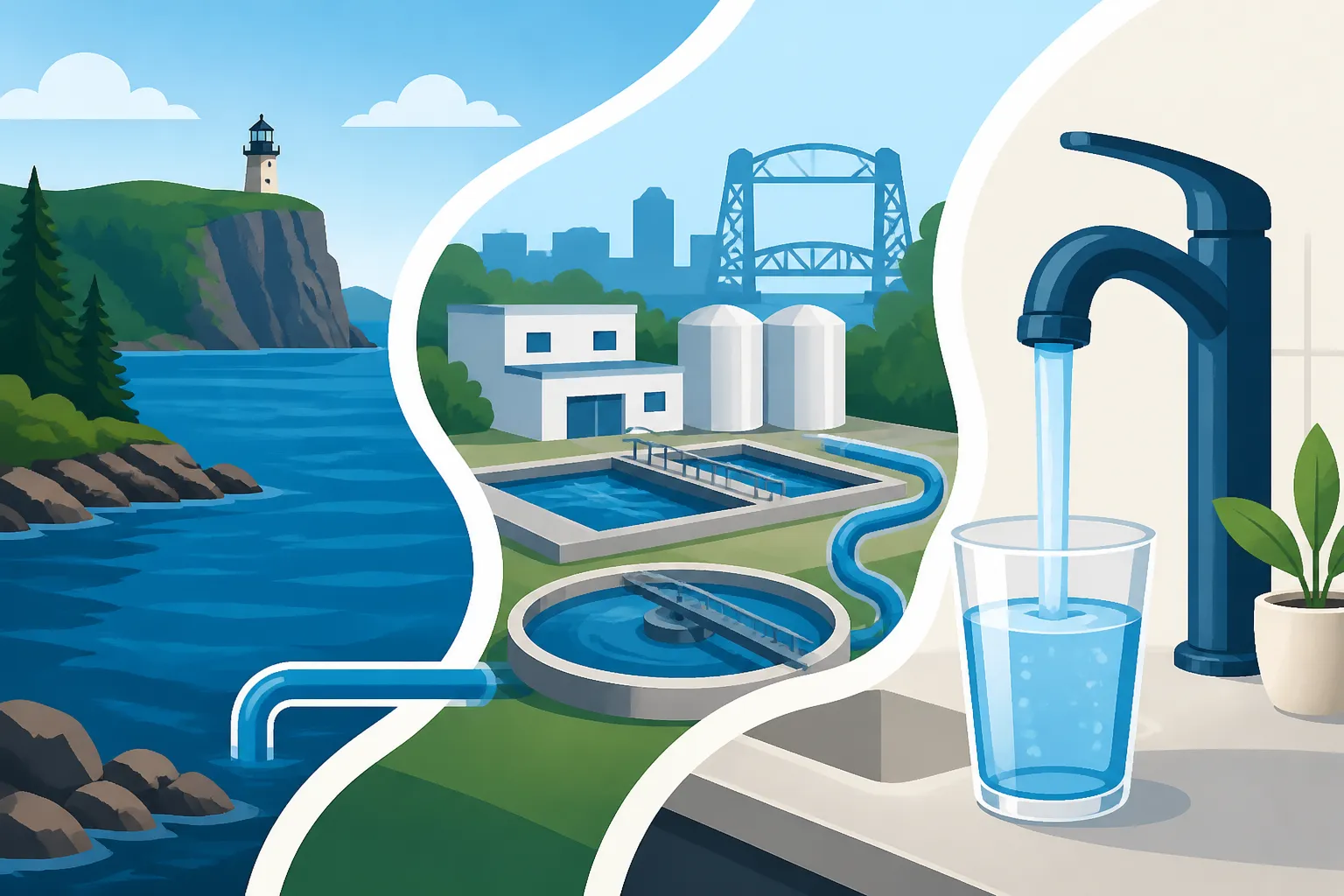
According to City of Duluth Public Works & Utilities, the source water supply for the City of Duluth is Lake Superior, a surface water source. That establishes where the city’s drinking water comes from. It does not, by itself, identify the treatment steps used, the equipment at the treatment plant, or what happens as water moves through the distribution system.
The distinction matters because water treatment depends on more than the source. A surface-water plant may use several treatment barriers, but the process is designed around the water’s characteristics and the utility’s system. A general description of how surface water can be treated is useful background, not proof that Duluth uses every step described.
Lake Superior is different from a private well or a supply drawn from a deep aquifer. Its water is open to the environment, so its characteristics can respond to natural conditions and activities within the watershed. That does not mean a change in the lake automatically creates a problem at the tap. Treatment and monitoring are intended to manage water before it enters the distribution system, while the current local report is the place to check the information the utility provides about its finished water.
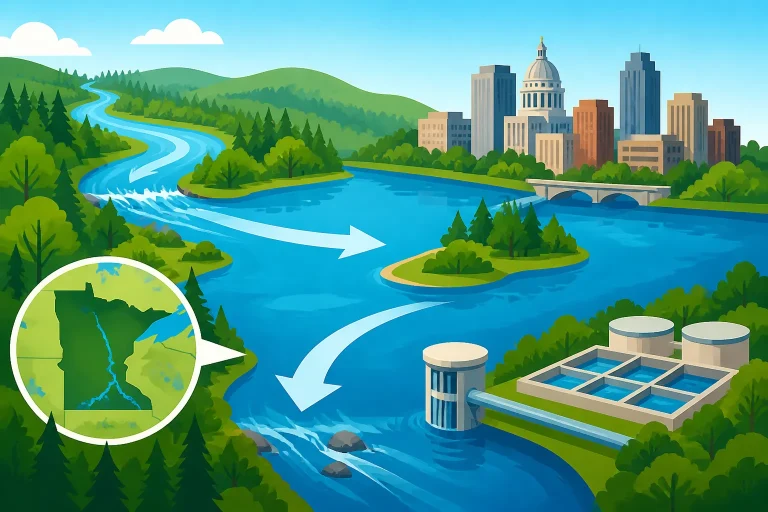
If you are comparing Duluth’s supply with another Minnesota city, first identify each system’s source. Minnesota systems may rely on surface water, groundwater, or a blend, so results and treatment choices are not automatically interchangeable. Minnesota Tap Water Sources: Surface Water and Groundwater Supplies gives context for those source differences.
For Duluth-specific treatment details, look for the city’s current drinking water information and annual water quality report. Check whether the document describes the source, treatment approach, monitoring results, and any notices or other relevant information. A report can help answer what is documented for the system; it should not be treated as a description of every possible treatment technology simply because that technology is common elsewhere.
How surface water can be treated before it reaches a tap
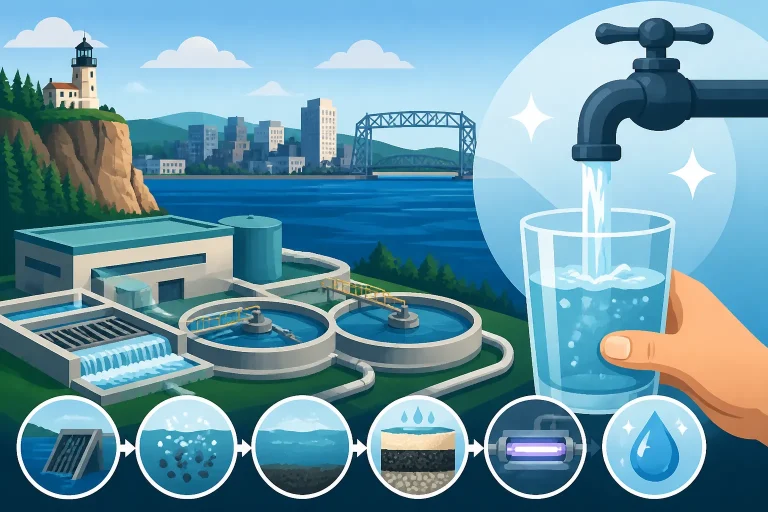
Surface-water treatment is generally built around multiple steps that address different concerns. The exact arrangement varies by system. The outline below describes common treatment functions, not a confirmed process map for Duluth.
| Treatment function | What it generally does | What to confirm for Duluth |
|---|---|---|
| Intake and screening | Moves source water into the treatment process and can keep larger debris out of downstream equipment | The city’s description of its intake and pretreatment |
| Particle removal | Helps separate suspended material from water | Whether and how the plant uses settling or another separation method |
| Filtration | Passes water through a treatment barrier designed to remove particles and other material | The filter type and performance information documented for the system |
| Disinfection | Provides a barrier intended to inactivate disease-causing microorganisms | The disinfectant used and related monitoring details |
| Distribution management | Maintains treated water as it travels through pipes and storage | Information on system monitoring and water quality at the tap |
Intake and early treatment
A treatment plant needs to bring water from its source into the plant and prepare it for later steps. Screening or other early processes can help remove larger material, but those are general treatment concepts. The presence, design, and operation of specific equipment at Duluth should be verified in the city’s own information.
Source-water conditions can also affect how a plant operates. Water may carry suspended particles or have changing characteristics, and treatment processes are selected and adjusted to meet the system’s needs. This is one reason a generic description cannot replace local operating details.
Separating particles
Many surface-water treatment approaches include a step that helps particles come together or settle out before filtration. In some systems, chemicals may help small suspended particles form larger clusters that are easier to remove. Other approaches may use different combinations of processes.
It would be a mistake to assume that Duluth uses a particular chemical or a particular settling method without a city source confirming it. For readers, the practical question is not just whether a treatment stage has a familiar name. It is whether the city documents that stage and provides information about how the finished water is monitored.
Filtration and disinfection
Filtration is a physical treatment barrier, but filters differ in design and intended performance. Disinfection is a separate treatment function: it is intended to inactivate microorganisms, rather than remove every dissolved substance. Treatment plants can combine barriers so that the overall process does not depend on a single step.
These general explanations should not be read as a claim that a particular filter type or disinfectant is used in Duluth. For those specifics, consult the city’s current treatment description or water quality report. For a broader look at treatment technology used in municipal systems, see Ultrafiltration Membranes: How City Plants Block Tiny Microbes and Carbon Filtration in Municipal Water: Treating River Water Taps. Those topics explain technologies; they do not establish which equipment Duluth operates.
A city treatment plant also differs from a household filter. Plant treatment is part of a public water system’s overall process, while a home device treats water at a specific faucet or throughout a building. If you are considering an additional filter, start with the issue you want to address and compare it with your own water information. Does Your Minnesota Municipal Water Actually Need a Filter? explains why a home filter is not automatically necessary for every public-water customer.
From treated water to the household faucet
Water treatment does not end at the plant outlet. Treated water travels through a distribution system of pipes and related infrastructure before it reaches homes and other buildings. The condition of that system, building plumbing, and the way water is used at a specific tap can all affect what a household experiences.
That does not mean a change in taste, color, or pressure proves the plant failed. Nor does it mean the treatment plant can explain every issue inside a building. The water system and household plumbing are different parts of the path. A concern that appears only at one faucet, for example, may need a different investigation from a concern affecting a whole neighborhood.
For a practical overview of how a municipal supply moves through the system, Treating Duluth Drinking Water: How Lake Superior Reaches Homes focuses on the route from source toward households. Can City Water Change Between the Treatment Plant and Your Faucet? discusses why conditions at the tap may not be identical to conditions leaving a treatment facility.
If water looks or smells unusual, note whether the change affects one fixture or several, whether it began suddenly, and whether the city has issued a notice. Avoid drawing conclusions from appearance or taste alone. A change may be a nuisance, a plumbing issue, or something that needs prompt follow-up; the appropriate next step depends on the circumstances and any official notice.
For a sudden neighborhood-wide change, check the water supplier’s current notices and contact information through its official website. For an issue limited to one home or fixture, a plumber or qualified water professional may help identify whether household plumbing or equipment is involved. If there is a health concern, ask a medical professional or local health department rather than relying on taste, smell, or a home filter as a health assessment.
How to check Duluth-specific treatment and water quality details
When you want a definite answer about treatment, look for a current source that describes Duluth rather than relying on general statements about surface-water plants. A useful review process is:
- Find the city’s current drinking water information or annual water quality report.
- Confirm that the document applies to the City of Duluth and the relevant reporting period.
- Look for a description of the source and the treatment process, not only a list of test results.
- Review the monitoring results and any notices or violations described in the report.
- If an important detail is missing, use the official city website to find current contact information and ask the water supplier directly.
A report’s tables can be difficult to interpret if you are unfamiliar with the terminology. Pay attention to what was measured, the unit used, the reported result, and any comparison value or explanation supplied with it. A detection does not automatically mean the water violates a standard, and a report’s summary should be read alongside its definitions and notes. How to Read Contaminant Detections on a Water Quality Report explains how to approach those entries. For the role and contents of annual reports, see Minnesota Annual Water Reports: Required Contents and Deadlines.
Keep the scope of each source in mind. A treatment description explains how the system says it processes water. A monitoring table reports particular sampling results under the conditions described in the report. Neither necessarily tells you the material of the pipes inside your home or the result from a sample taken at your personal faucet.
If your question is about a particular household, such as whether a home’s plumbing affects its tap water, the citywide report may not answer it. A public water report describes information for the system; it is not an individual test of every fixture. For a concern about lead, for example, use information specific to household plumbing and sampling rather than assuming a citywide result describes every tap. Does Your City Water Quality Report Measure Lead at Your Home Tap? explains that difference.
When contacting the supplier, ask a focused question. You might ask which treatment steps the city currently uses, where that information appears in its report, or what monitoring applies to the issue you have noticed. A clear question makes it easier to separate general background from a Duluth-specific answer.
What the source fact does and does not tell you
The confirmed source fact is straightforward: Duluth’s drinking water comes from Lake Superior, which is a surface water source. That is a helpful starting point for understanding the supply, but it does not answer every question about treatment or household water.
It does not establish which filtration method Duluth uses, what disinfectant is used, whether the plant changes its operating approach under particular conditions, or what happened at a particular faucet. It also does not tell a reader whether a household needs a filter. Those questions require different evidence.
A useful way to evaluate claims you encounter is to ask:
- Is the claim specifically about Duluth, or is it a general description of surface-water treatment?
- Does the source identify the treatment step, or merely describe what a typical plant might do?
- Is the information from the city’s current report or treatment description?
- Is the claim about water leaving the plant, water in the distribution system, or water at a household tap?
- Does the evidence address the particular concern, rather than a different water-quality question?
This helps avoid two opposite mistakes: assuming that a familiar treatment step is definitely used in Duluth, and assuming that limited public detail means the water is untreated. The responsible approach is to distinguish what the source information confirms from what needs further verification.
The same care applies to filters. A household filter should be selected for a specific contaminant or water-quality concern, and its certification should match the intended reduction and the results being addressed. A device’s general marketing description is not a substitute for checking its certification and maintenance requirements. A home filter also cannot be treated as proof that water is safe or unsafe. For questions about health effects, consult a medical professional or local health department.
Frequently Asked Questions
Does Duluth get its drinking water from Lake Superior?
Yes. According to City of Duluth Public Works & Utilities, the source water supply for the City of Duluth is Lake Superior, a surface water source.
Does that confirm which treatment process Duluth uses?
No. The source information identifies Lake Superior as the supply, but it does not specify the plant’s treatment steps or equipment. Check the city’s current drinking water information for those details.
Is every common surface-water treatment method used in Duluth?
That cannot be concluded from the source fact alone. General descriptions of screening, particle removal, filtration, or disinfection explain possible treatment functions; they are not confirmation of Duluth’s specific process.
Does the source fact mean a household filter is needed?
No. Knowing the source does not determine whether a particular home needs a filter. Check the current water quality information and match any filter to a specific concern and verified certification.
Sources
- City of Duluth Public Works & Utilities — Water Quality Report | City of Duluth, MN (checked November 13, 2026)
Disclaimer
This article is for general informational purposes only and does not constitute professional advice. Laws, prices and regulations vary by location and change over time. Consult a qualified professional for guidance on your specific situation. Minnesota Water Guide is not a government agency or water utility and is not affiliated with any public water system.