How Lake Superior Water Is Treated for Duluth Area Taps
Lake Superior is the source of Duluth’s drinking water, but that fact alone does not show what happens between the lake and a kitchen tap. The treatment process matters, as do the limits of what a public water report can tell you about one home. Here’s how to understand the general treatment steps and find the details that apply to Duluth.
What Lake Superior’s role means for Duluth tap water
According to City of Duluth Public Works & Utilities, the source water supply for the City of Duluth is Lake Superior. The utility’s 2025 report also identifies Lake Superior as the drinking water source. That establishes where the water begins; it does not, by itself, describe every treatment step or prove what the water is like at a particular faucet.
Lake Superior is a surface water source. Surface water can carry naturally occurring particles and organic material, as well as substances that enter a lake from its watershed. The amount and type of material can vary with conditions in the lake and its surroundings. That is one reason a water utility treats source water before sending it through the distribution system.
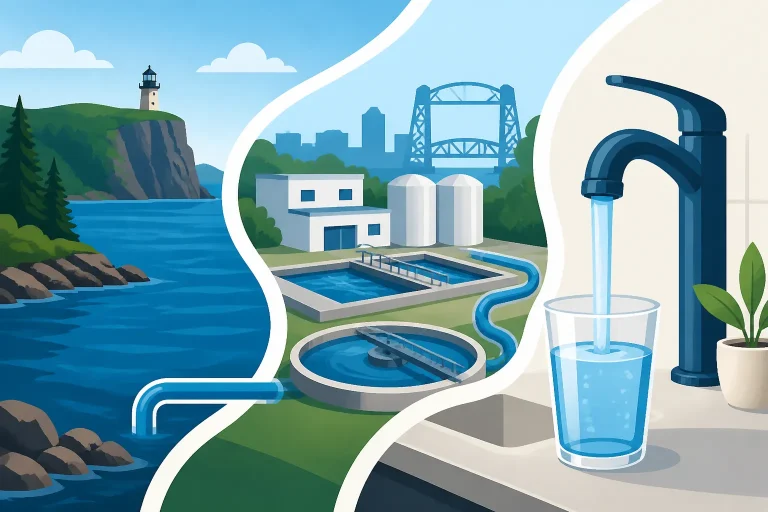
Treatment is a sequence of barriers, not a single action. Depending on the system and the characteristics of its source water, a plant may use processes that remove particles, reduce certain contaminants, and disinfect the water. After treatment, water travels through pipes and other infrastructure before reaching homes and businesses. The details of that journey matter: a report about water leaving a plant does not necessarily describe plumbing inside a particular building.
It is important not to fill in missing details with assumptions. Knowing the source is Lake Superior does not establish which treatment processes Duluth uses, what chemicals it adds, or how the water is adjusted before distribution. Those specifics should come from Duluth’s own current water-quality information. For a related look at source and treatment, see From Lake Superior to the Faucet: Duluth Water Treatment and Is Lake Superior Tap Water Filtered and Disinfected in Duluth?.
A municipal system is responsible for managing water across its service area. A household, by contrast, may have plumbing materials or conditions that differ from those in another home. This distinction helps make sense of questions such as “Is Duluth tap water treated?” and “Does a report describe the water at my faucet?” The first is about the public system; the second may also depend on the building’s plumbing and how the tap is used.
How surface water treatment generally works
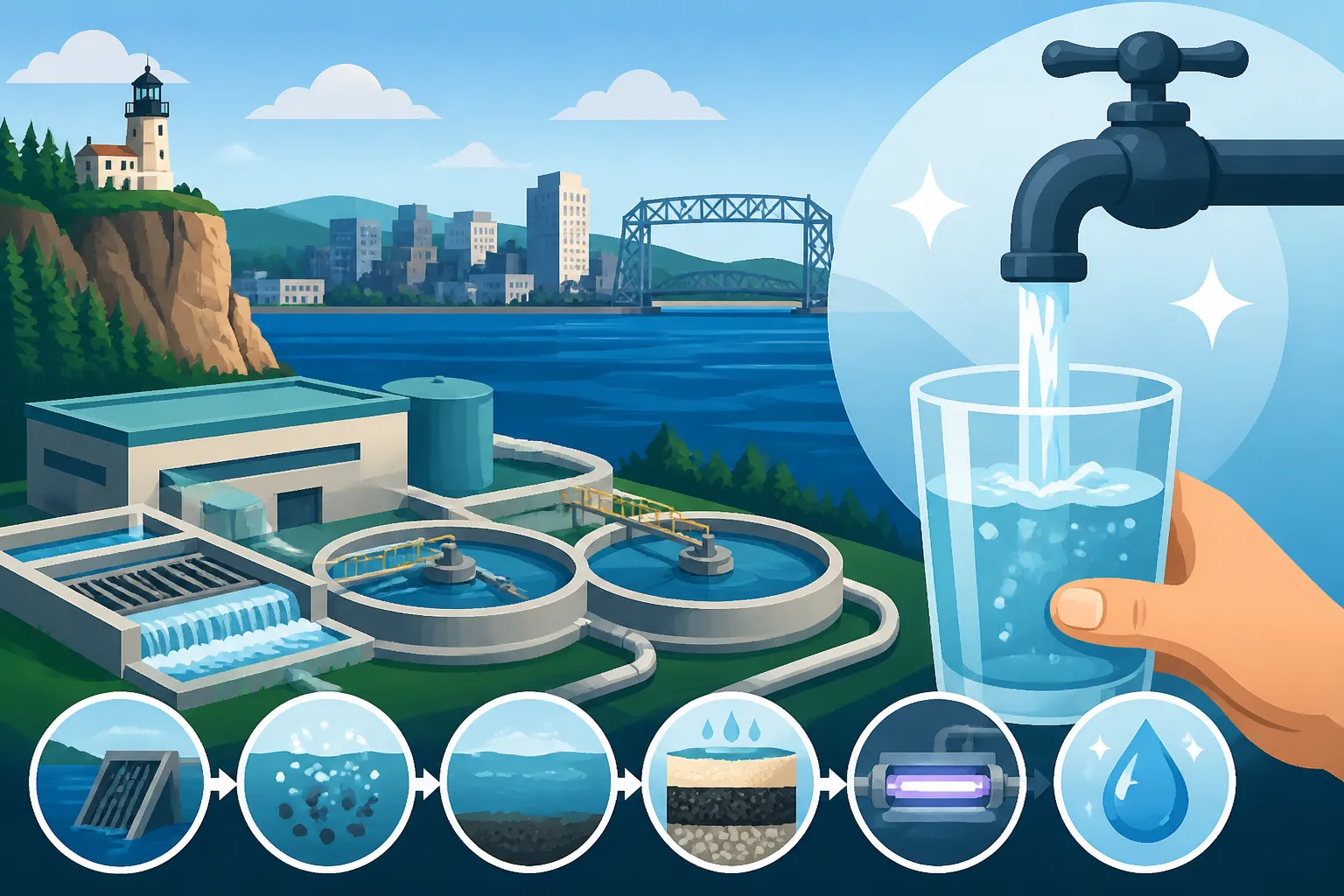
The steps in a surface water plant are selected to suit the water and the treatment system. The stages below explain common functions, not a confirmed description of Duluth’s plant. To know which ones Duluth uses, and in what order, check City of Duluth Public Works & Utilities’ current material about its treatment process.
Intake and early screening
A treatment process begins when water is drawn from its source. Screening at an intake can keep larger debris from entering equipment. The design and operation of an intake depend on local conditions; screening does not, by itself, make water ready to drink.
Source water is also monitored so operators can respond to changes that matter to treatment. Surface water may vary in clarity or in the amount of organic material it carries. Conditions can shift over time, so water treatment is designed to manage the source rather than assume it remains identical throughout the year.
Removing suspended particles
Many surface water treatment processes use steps intended to bring small suspended particles together so they can be separated from the water. A process may use a treatment chemical to help particles clump, followed by settling or another form of separation. Filtration can then capture particles that remain.
These steps address different parts of the problem. Settling can remove material that has become heavy enough to separate from the water; filtration can capture smaller particles that remain in the flow. The details, including the equipment and materials involved, vary among water systems. Do not assume a particular treatment chemical or filter type is used in Duluth unless the utility’s current documentation says so.
For more on particle removal in municipal treatment, How Minnesota Clarifies Turbid River Water Before It Hits the Tap describes a related surface-water process. It is useful background, but it should not be treated as a record of Duluth’s treatment sequence.
Disinfection and other treatment goals
Disinfection is used in public water treatment to reduce disease-causing microorganisms. Systems select and manage disinfection based on their source, plant design, and applicable requirements. Disinfection is distinct from particle removal: clarifying or filtering water does not automatically tell you what disinfection method is used.
A water utility may also adjust water characteristics to support treatment or protect the distribution system. Those decisions are specific to the system. The term “treated” is not a complete list of processes, and it does not mean every possible substance has been removed. Each process has a defined purpose and limits.
A useful way to read a description of treatment is to connect each step to its job: what is the process intended to remove or control, at what point does it happen, and how does the utility check that it is working? If public information does not answer those questions, avoid guessing. Use the utility’s current report or contact details on its official website to seek clarification.
Why water quality can change along the way
Water leaving a treatment plant still has to travel through a distribution network. Water mains, storage facilities, connections, and building plumbing are all part of the broader path to a faucet. A public water report is an important source of information about the system, but it cannot describe every condition inside every property.
The public system and the home are different parts of the path
A utility’s treatment processes apply to water it manages. Once water enters a building, its contact with household plumbing can affect what comes out of a particular tap. Pipe and fixture materials, plumbing condition, and whether water has been sitting in the plumbing can all be relevant when investigating a change at one location.
This does not mean that a change at a tap proves a problem with the city’s treatment. Nor does it mean that a system-wide report can rule out an issue in a particular home. The source, treatment plant, distribution system, and building plumbing are connected, but they are not interchangeable when diagnosing a concern.
For lead questions, for example, a report for the public system is not a substitute for understanding the plumbing at a specific property. See Does Your City Water Quality Report Measure Lead at Your Home Tap? and Lead in Minnesota Tap Water: Pipe Goosenecks vs Indoor Plumbing for more on how tap conditions and plumbing materials fit into the picture.
Changes in appearance, taste, or smell
A sudden change in water’s appearance, taste, or smell can have more than one possible explanation. It may relate to conditions in household plumbing, nearby utility work, or a change in the public system. The sensation itself does not identify the cause or establish whether the water is safe.
Start by noting what changed and where. Is the issue limited to one faucet, or does it occur throughout the home? Does it affect cold water, hot water, or both? Does it persist after routine use, or appear after water has been sitting? These observations can help explain the situation to the utility or a qualified plumbing professional, but they are not a substitute for their assessment.
If the change is sudden, widespread, or accompanied by an official notice, check current information from the utility rather than relying on general explanations. For practical first checks, see Discolored or Smelly Tap Water: What to Check First at Home and Minnesota Tap Smells or Tastes Off: Hazard or Just a Nuisance?.
How to use a Duluth water-quality report
A water-quality report is the best place to look for system-specific information about source water, monitoring, and reported results. The utility’s report can help answer what was measured and how findings are presented. It cannot provide every detail about the water at an individual tap, and its treatment description should be read as system information rather than a diagnosis of a particular home.
Look for source and treatment descriptions
Begin with the report’s description of the water source and treatment. Check whether it names the source, explains the treatment processes, or provides a contact route for questions. A source statement tells you where the water originates. A treatment description should tell you more about the steps the utility uses. If the report gives only a broad summary, do not infer technical details that it does not state.
Where the report does name a process, read its purpose in context. A treatment step designed to remove particles does not necessarily remove dissolved substances. A disinfection step has a different role from filtration. A statement about one process should not be interpreted as a guarantee that all possible contaminants are absent.
Read results with their context
Reports may present contaminant names, monitoring results, and comparison values. The meaning of an entry depends on what was tested, how it was measured, and the reporting context. A detected result is not automatically the same as a violation, and a result that is not listed does not establish that a substance was tested at every tap or at every moment.
Look for the report’s explanation of the measurement and the applicable comparison standard. If a term or result is unclear, consult How to Read Contaminant Detections on a Water Quality Report. That article can help with report interpretation, but the Duluth report remains the source for Duluth-specific data.
Also note what the report does not show. System monitoring is not the same as a test of an individual home’s tap. If your concern relates to a particular faucet, plumbing material, or a known change inside the building, the system report may not answer it. The next step may be to ask the utility what testing is available or seek advice from a qualified professional about the property.
Confirm that the information is current
Use the most recent report available from City of Duluth Public Works & Utilities and read its reporting period carefully. Details can change as systems update operations, monitoring, or public materials. Avoid relying on an old report to answer a current question about treatment or water quality.
For other questions, such as how monitoring works across public systems, How MDH and Local Utilities Routinely Sample Minnesota Tap Water offers broader context. It does not replace Duluth’s own report or establish what happened at a specific faucet.
When a home filter might help
A filter is not automatically necessary just because the water comes from a lake, and it is not a substitute for understanding the issue you want to address. Different devices are designed to reduce different substances. Choosing a filter without identifying a relevant concern can lead to an unnecessary purchase or a device that does not match the water conditions.
Start with the question, not the product. Are you trying to change taste or odor, address a particular contaminant identified in a report, or respond to a concern about household plumbing? Those are different goals and may call for different next steps. A filter’s advertised purpose is not enough: check its certification and the specific reduction claim against the contaminant and test results relevant to your home.
A system-wide report can guide your understanding of public water, but it may not resolve a plumbing-specific question. If a concern is limited to one property, consider whether testing at the tap or an assessment of the plumbing is appropriate. If the question is about a reported health effect, ask the local health department or a medical professional rather than relying on a filter description.
Filters also need proper installation and maintenance. A device that is not maintained according to its instructions may not perform as intended. Before buying, check what it is designed to reduce, whether its certification matches that claim, how it is installed, and what upkeep it requires. Does Your Minnesota Municipal Water Actually Need a Filter? and Filtering City Tap Water: Under-Sink Unit or Whole-House? can help compare the decision and the types of systems available.
The practical takeaway is to match treatment to evidence. If the utility report identifies a concern, confirm what it means and whether it applies to the water delivered to your property. If the concern is taste, odor, or a plumbing material, use information relevant to that issue. A general-purpose filter should not be treated as a universal solution.
What to do when you have a question about Duluth tap water
A clear process can keep a concern from turning into guesswork. Begin with the source and system information, then narrow down whether the question is about the public supply or one property.
- Check the official utility information. Find the current report and any current notices or treatment description on the official City of Duluth Public Works & Utilities website. Use that source for current contact details.
- Describe the concern precisely. Note whether it affects one tap or several, whether it is about taste, odor, appearance, a report result, or a plumbing material, and when it began.
- Compare the concern with the report. Look for the relevant treatment description, monitoring result, and explanation. Do not treat a result from the public system as a test of your home’s plumbing.
- Ask the right professional. Contact the utility about the public system or a system-wide change. For a question focused on building plumbing, a qualified plumbing professional may be appropriate. For health questions, consult the local health department or a medical professional.
- Use a filter only for a defined purpose. Match its certification and reduction claim to the specific water-quality concern, and follow the manufacturer’s maintenance instructions.
If the utility has issued an advisory or notice, follow its instructions and check for updates through the official utility website. General treatment information cannot override a current local notice. For more on how Minnesota public water notifications work, see Minnesota Drinking Water: Public Notification and Advisory Rules.
The same approach applies when trying to understand a routine change. A taste difference alone does not identify a contaminant; an old report may not answer a current question; and a filter label does not show that the device is suitable for every concern. Keep the question specific, use current Duluth information, and distinguish the public system from the plumbing inside the property.
Frequently Asked Questions
Is Duluth’s drinking water from Lake Superior?
Yes. City of Duluth Public Works & Utilities identifies Lake Superior as the source water supply for the City of Duluth.
Does knowing the source tell me which treatment steps Duluth uses?
No. The source statement identifies where the water comes from, not the exact treatment sequence. Check current information from City of Duluth Public Works & Utilities for the treatment details it publishes.
Does a city water report describe the water at every home faucet?
A report provides information about the public system and its monitoring. It does not necessarily describe conditions in an individual building’s plumbing or at every tap.
Should every Duluth home use a drinking-water filter?
Not automatically. First identify the concern, then check whether a filter is certified for the specific reduction you need and whether that claim matches relevant test results or utility information.
Sources
- City of Duluth Public Works & Utilities — Water Quality Report | City of Duluth, MN (checked November 13, 2026)
Disclaimer
This article is for general informational purposes only and does not constitute professional advice. Laws, prices and regulations vary by location and change over time. Consult a qualified professional for guidance on your specific situation. Minnesota Water Guide is not a government agency or water utility and is not affiliated with any public water system.