St. Paul Water Sources: How River Water Moves Through Lakes
If you have heard that St. Paul’s water comes from both a river and lakes, it is natural to wonder whether river water travels through the lakes before reaching your tap. The source list answers where the city’s drinking water primarily comes from, but not the exact route it follows. Here is how to interpret that distinction and what to check when you want the details of the local water system.
What St. Paul’s listed water sources tell you
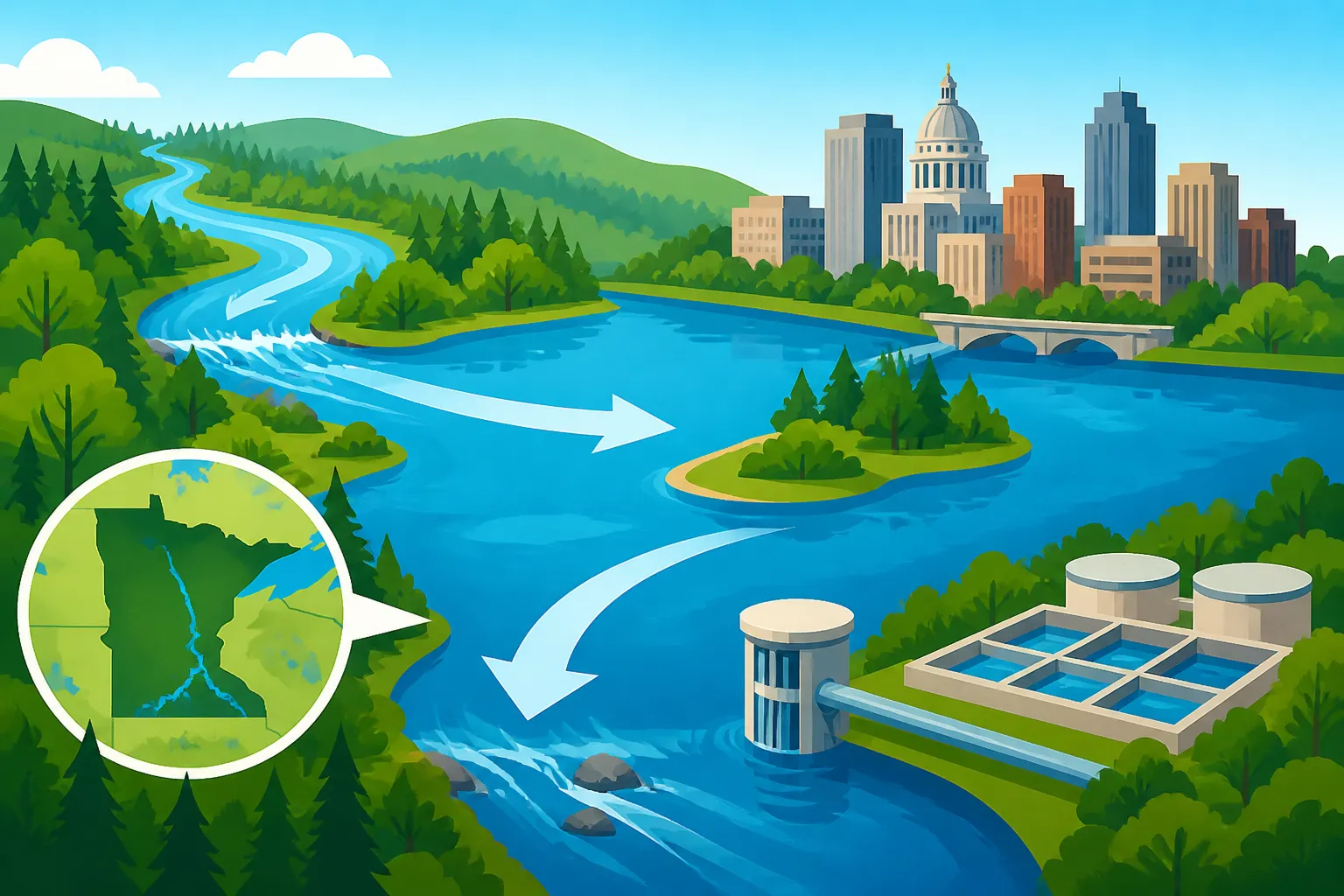
Saint Paul Regional Water Services identifies the primary drinking-water sources for Saint Paul as the Mississippi River and the Chain of Lakes. That is useful information, but it does not describe every step between those sources and a household faucet. In particular, naming a river and a group of lakes does not, by itself, establish that all river water flows through the lakes before it is treated.
The report also describes Saint Paul’s drinking water as primarily coming from the Mississippi River and the Chain of Lakes. The word “primarily” matters: it identifies the main sources without giving a complete operating account of when each source is used, how much water comes from each, or whether a particular customer’s water came from one source at a particular moment.
For a customer, it helps to separate three questions:
- Where does the raw water come from? The listed sources are the Mississippi River and the Chain of Lakes.
- What route does the raw water take? The source description does not give a complete route or establish how the river and lakes connect to one another in the water system.
- What happens before water reaches a tap? Source information alone does not explain the treatment steps, storage, or distribution network.
These questions are related, but they are not interchangeable. A source is where water originates for the supply. A route is the path water takes through intake structures, pipes, reservoirs, or other parts of a system. Treatment is the set of processes used to prepare water for distribution. Distribution describes how treated water reaches different parts of the service area.
That distinction is the key to reading a short source summary without reading more into it than it says. A source list can identify the broad origins of water while leaving the operating details to a separate description of the utility’s facilities and procedures. For context on the river portion of the supply, see Mississippi to Tap: St. Paul’s Surface Water Path. For broader background on surface-water and groundwater sources, see Minnesota Tap Water Sources: Surface Water and Groundwater Supplies.
Does Mississippi River water move through the Chain of Lakes?
It might, depending on what someone means by “moves through.” Water in a regional supply can pass through natural water bodies, be diverted into a managed storage area, or be conveyed through built infrastructure. Those are different arrangements, and a source list alone cannot tell you which one applies to St. Paul’s supply.
The phrase “the Mississippi River and the Chain of Lakes” names two primary sources. It does not say that the lakes are a mandatory passage on the way from the river to the treatment plant. It also does not specify whether water from the river and the lakes is collected separately, blended, used at different times, or routed through any shared facilities. Avoid assuming that one source feeds the other just because both appear in the same sentence.
There are several possible meanings behind the idea that river water moves through lakes:
- A river may naturally flow into or out of a lake as part of a watershed.
- A water utility may use a lake or reservoir as a source or as part of a managed supply system.
- A lake may collect water from its surrounding watershed without serving as a passage for a particular utility’s river water.
- A utility may use infrastructure to transfer, store, or blend water, but the source description does not establish that this happens.
Those are general ways that water bodies can relate to one another. They are not a claim about the precise Saint Paul route. To make that claim, a description would need to identify the relevant water bodies and facilities and explain how water moves between them. Without that information, the most accurate reading is that the Mississippi River and the Chain of Lakes are primary sources, not that the river necessarily travels through the lakes before treatment.
This distinction is especially useful when reading a map or hearing a brief explanation of the system. A map may show rivers and lakes near one another, but proximity does not prove that a utility draws water from a specific location or transfers it along a particular route. Likewise, a general description of lake storage does not show that a city’s actual supply uses a particular lake in that way.
If you want the direct answer about the operating route, look for a current utility description that addresses the source intakes and how they connect to the treatment process. A report that only names the sources is not enough to answer that question. Related background is available in How Lake Storage Protects St. Paul’s River Water Supply, but for a current, system-specific description, use Saint Paul Regional Water Services’ official information.
How rivers and lakes can fit into a drinking-water supply
It is helpful to understand the roles rivers and lakes can play in a water supply without assuming that every system uses them in the same way. Both are surface-water sources: they are open bodies of water exposed to weather, runoff, and changing conditions in the surrounding watershed. Their characteristics and possible uses differ, but the presence of either does not, by itself, describe how water is collected or treated.
A river is moving water. Its flow can carry water from upstream areas and bring along changes in temperature, sediment, dissolved material, and other characteristics of the source. What is present at a particular intake can depend on conditions in the river and its watershed. A utility’s source information identifies the river as an origin of water; it does not specify the exact intake location or the conditions at that intake.
A lake is water held within a basin. Compared with a flowing river, a lake can have different patterns of mixing, settling, and temperature change. Those patterns vary with the lake’s size, depth, shape, weather, and water movement. In some water systems, lakes or reservoirs can be used to store water or manage supply. That is a general possibility, not proof that every named lake is used as a storage facility or that it receives water transferred from a river.
The ways water bodies interact are also specific to local geography and infrastructure. A lake can be connected to a river through natural channels, receive water from nearby land, or be hydraulically separate from a source intake even if it is geographically nearby. A utility may draw from more than one source without those sources physically merging in the way a reader might picture.
The table below separates what the source description establishes from what still needs a system-specific answer.
| Question | What the source description establishes | What needs a separate utility explanation |
|---|---|---|
| Which primary sources are named? | The Mississippi River and the Chain of Lakes | The specific intake locations |
| Does the river flow through the lakes before treatment? | The description does not establish that route | Whether a physical or managed connection exists |
| Are the river and lake sources blended? | The description does not say | How sources are used or combined |
| Does every neighborhood receive water from the same source at all times? | The description does not say | How sources and distribution are managed |
| What treatment does the water receive? | The source description does not list treatment steps | The treatment process and how it relates to each source |
A useful next step is to read the utility’s treatment and source information together. A source page can identify origins; a treatment description can explain what happens after collection. The distinction is also covered in How Lake Superior Water Is Treated for Duluth Area Taps, which offers a separate example of how source and treatment information can be discussed without treating them as the same thing.
Why a water system might use more than one source
A system may have more than one primary source for practical reasons, but the source list alone does not tell you which reasons apply in Saint Paul. In general, multiple sources can give a utility options for managing supply, responding to changing conditions, or meeting demand. The exact purpose depends on the infrastructure, operating rules, and characteristics of the sources.
For example, a utility with access to more than one source might be able to adjust which source it uses as conditions change. That could involve operational choices related to water availability or source quality. It would be a mistake, however, to infer from a list of sources that a specific source is reserved for emergencies, used only in a particular season, or selected because another source is unsuitable. Those are operational claims that require direct confirmation.
A second source can also be part of a broader supply plan. Different sources may have different physical characteristics, and a utility needs to understand how those characteristics affect treatment and distribution. That does not mean that one source is inherently safe or unsafe, or that one source always produces better water. It means the system must account for the water it collects and use processes appropriate to its operating conditions.
The source information provided by Saint Paul Regional Water Services does not state:
- How frequently each source is used
- Whether the sources are used simultaneously
- Whether the sources are blended before or during treatment
- Whether one source is used more during a particular season
- How much of the supply comes from each source
- Whether every customer receives water from the same source mix
- Whether the system changes sources in response to specific river or lake conditions
These are reasonable questions for customers to ask, especially if they are trying to understand why a utility lists both a river and lakes. They are not answers that can be derived from the source names alone.
When a utility has more than one source, a customer may also encounter different descriptions in different documents. One may emphasize the main source, while another may describe the system more broadly. That difference does not automatically mean the information conflicts. Documents can have different purposes: one may summarize source origins, while another may explain the treatment plant, intake, or distribution network. Check what each document is describing before comparing statements.
A detailed explanation of a source portfolio should make clear whether it is talking about natural water bodies, actual withdrawal points, supply facilities, or the water that enters a treatment process. If those terms are used loosely, the description can sound as though water follows a route that has not actually been established. For a wider look at how cities can use combined supplies, see Blended Tap Supplies: Combining Deep City Wells With River Water. That example is not evidence of how Saint Paul operates; it illustrates why a specific explanation of source connections matters.
What can change in river and lake source water
Surface water changes over time. The water in a river or lake can be affected by weather, runoff, seasonal conditions, and natural processes in the watershed. That general pattern helps explain why a utility monitors and treats source water, but it does not establish that any particular event has affected Saint Paul’s supply or that a household should expect a particular change at the tap.
A river may respond quickly to changes upstream or in nearby tributaries. For instance, rainfall can carry soil and other material from land into waterways. Flow and clarity can shift, and seasonal changes can affect water temperature. A lake may respond differently, as water movement and conditions can vary across locations and depths. These are broad characteristics of surface water, not a description of current conditions in any named Saint Paul source.
The source itself is also only one part of the finished water picture. A change in a river or lake does not tell a customer what reaches the tap after the utility collects and treats the water. To understand that, you need information about the treatment process, water-quality monitoring, and any utility notices that apply to a specific event.
Customers sometimes try to infer source-water conditions from a change in taste, smell, color, or pressure at home. Those observations can be useful clues that something has changed, but they do not identify the cause. A temporary taste difference may not mean that water came from a different source. Discoloration may be related to household plumbing or distribution conditions rather than the original source. Likewise, a normal-looking tap does not tell you which source the utility used.
For practical troubleshooting, start with the utility’s current notices and your household plumbing conditions rather than guessing that a river or lake source is responsible. Minnesota Tap Smells or Tastes Off: Hazard or Just a Nuisance? explains how to think through taste and odor changes, while Discolored or Smelly Tap Water: What to Check First at Home covers household checks that can help narrow down a problem.
If the concern is about a possible health effect, ask a local health department or medical professional for guidance. If you want to know whether a source-water issue has affected public water, check Saint Paul Regional Water Services’ official notices and water-quality information. Do not use a change in taste or appearance as a substitute for an official advisory.
Source water is not the same as tap water
A drinking-water source is the water before it has completed the steps needed for delivery to customers. Tap water is the water that has passed through the utility’s treatment and distribution processes and then through the plumbing serving a particular building. Knowing the source is a useful first step, but it cannot answer every question about the quality of the water at a specific faucet.
Treatment information matters because it describes what the utility does with the source water. Monitoring information matters because it shows what the system measures and reports. Distribution matters because water travels through pipes and equipment after it leaves a treatment facility. Household plumbing matters because a tap is connected to the building’s own pipes and fixtures.
This does not mean a customer should assume there is a problem between the treatment plant and the faucet. It means that “Where does the water come from?” and “What is in the water at my tap?” are different questions. A source description answers the first in broad terms. A water-quality report, sampling information, or a targeted home test may be needed for more specific questions.
The type of report you need depends on what you are trying to learn:
- If you want the general origins of the public supply, look for the utility’s source information.
- If you want to understand treatment, look for a description of the treatment process.
- If you want to review reported results for the public system, consult the water-quality report.
- If you want information about lead or other materials in a particular building’s plumbing, public-system results may not answer that household-specific question.
- If there is an active advisory, follow the instructions in the utility’s current notice rather than relying on a general source summary.
For help interpreting a public report, see Key Details to Check in Your Minnesota Drinking Water Report and How to Read Contaminant Detections on a Water Quality Report. Those topics can help you distinguish the source description from monitoring results and explain why a report’s scope matters.
A report is most useful when read in context. Check which system it covers, what period it describes, and whether it presents results for the public supply or for particular sampling locations. A systemwide report is not necessarily a test of the water at every household faucet. If you have a concern tied to your own plumbing, the question may require different information or sampling than a general source report provides.
How to verify the route and understand your own water
If you want to know whether Mississippi River water moves through the Chain of Lakes, look for a description that explains the actual connection rather than relying on the source list alone. The most useful information will identify the source locations, explain how water is conveyed, and clarify whether the lakes function as sources, storage, or part of a managed route.
A practical way to investigate is to follow these steps:
- Start with the source statement. Confirm which water bodies the utility names as primary sources. Saint Paul Regional Water Services identifies the Mississippi River and the Chain of Lakes.
- Find a system description. Look for information about intakes, conveyance, storage, and treatment facilities. A source list by itself may not describe those connections.
- Check the wording carefully. “Source,” “storage,” “reservoir,” “intake,” and “treatment” refer to different parts of a water system. A document that names a source does not necessarily explain the route water follows.
- Look for operational details. If you want to know whether sources are blended or used at different times, look for an explicit statement. Do not infer a schedule or source mix from a general overview.
- Read the water-quality report for its intended scope. A report about the public system can provide useful monitoring information, but it may not describe the path to a specific building’s tap.
- Use official utility information for current details. If an online summary does not answer the route question, use Saint Paul Regional Water Services’ official website to find current contact details and ask for the relevant system explanation.
When asking a question, make it specific. Instead of asking only whether the city uses river water and lakes, ask whether the river water physically passes through any of the lakes, whether the lakes are separate sources, and how those sources connect to treatment. You can also ask whether the answer refers to natural waterways or utility infrastructure. Those distinctions make it easier to get a useful explanation.
If your main concern is the quality of water at home, start with the public water report and the utility’s current notices. Then consider whether the question concerns public-system water or materials inside the home. For lead-related concerns, Does Your City Water Quality Report Measure Lead at Your Home Tap? explains why a system report may not be the same as a test of an individual faucet. For more on service-line questions, see Who Owns the Water Service Line? Public vs Private Side Rules.
A home filter is a separate decision from understanding the source route. Do not choose a filter based only on the fact that the supply comes from a river or lakes. First identify the contaminant or water characteristic you want to address, review relevant test or report information, and check that any product’s certification matches that need. Does Your Minnesota Municipal Water Actually Need a Filter? offers a framework for deciding whether treatment at home is necessary.
Frequently Asked Questions
Does St. Paul get drinking water from the Mississippi River?
Saint Paul Regional Water Services identifies the Mississippi River as one of Saint Paul’s primary drinking-water sources. The report also names the Chain of Lakes.
Does Mississippi River water flow through the Chain of Lakes before reaching St. Paul taps?
The source description does not establish that route. It identifies the Mississippi River and the Chain of Lakes as primary sources but does not explain whether they connect or how water moves between them.
Are the river and lake sources mixed together?
The source information does not say whether the sources are blended, used separately, or used in different operating conditions. Check Saint Paul Regional Water Services’ official information for a system-specific explanation.
Does knowing the source tell me what is in my home’s tap water?
Not by itself. Source information identifies where water originates in broad terms. Public water-quality reports, utility notices, and, when appropriate, household sampling address different questions about water quality and plumbing.
Sources
- Saint Paul Regional Water Services — Annual Water Quality Report | Saint Paul Minnesota (checked November 13, 2026)
Disclaimer
This article is for general informational purposes only and does not constitute professional advice. Laws, prices and regulations vary by location and change over time. Consult a qualified professional for guidance on your specific situation. Minnesota Water Guide is not a government agency or water utility and is not affiliated with any public water system.